· By Jennifer Frey
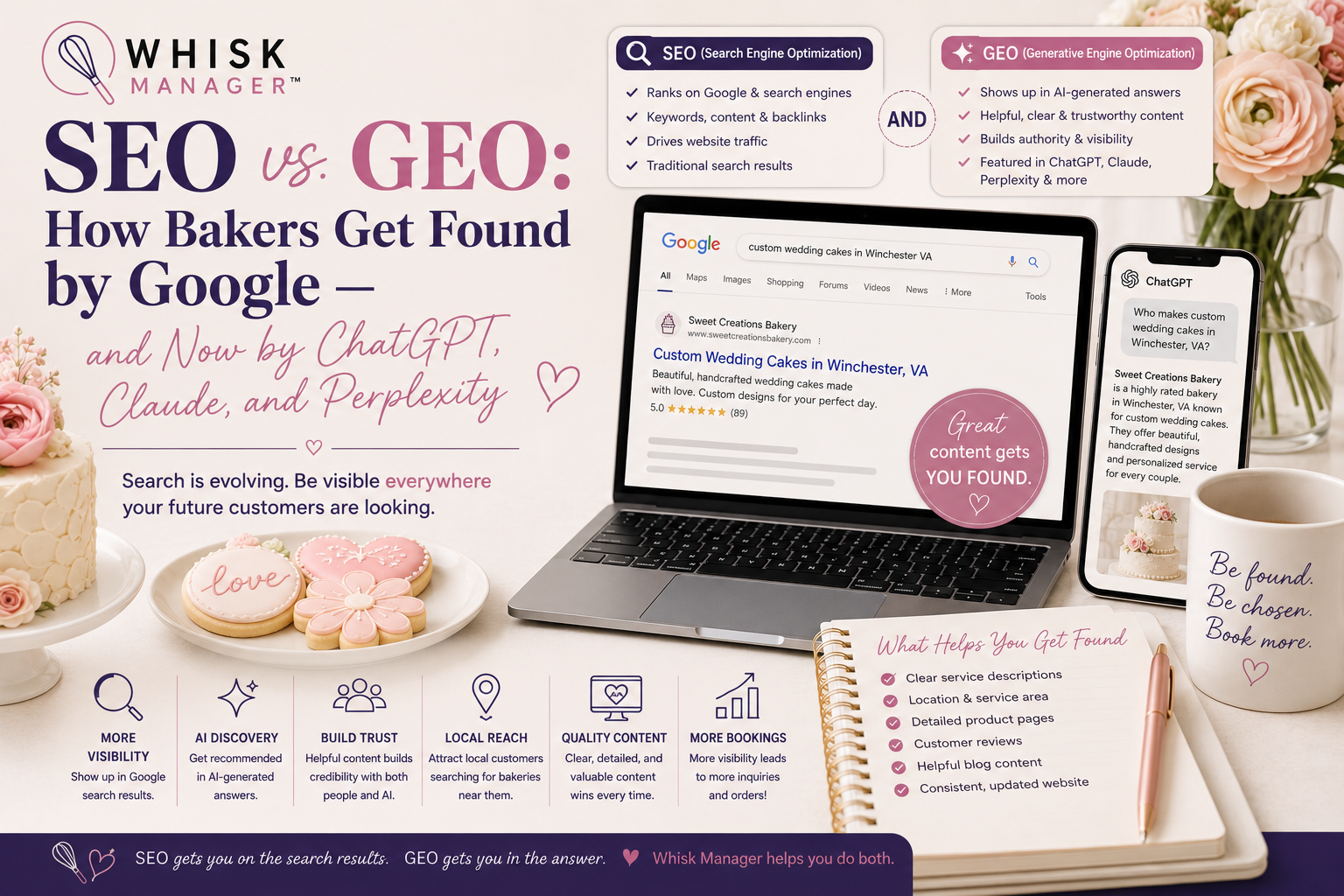
SEO vs. GEO: How Bakers Get Found by Google — and Now by ChatGPT, Claude, and Perplexity
Google isn't the only front door anymore. Here's the real difference between SEO and GEO/AEO, what it takes to do it yourself, and how your Whisk Manager Shop Page handles the technical side for you.
A few years ago, "getting found online" meant one thing: showing up on Google. Today, a growing number of your future customers aren't typing "custom cookies near me" into a search bar at all. They're asking ChatGPT, Claude, or Perplexity a full sentence — "Who makes good custom birthday cookies near Winchester VA?" — and trusting whatever answer comes back.
That's a real shift, and it comes with a new acronym to go along with SEO: GEO (Generative Engine Optimization) or AEO (Answer Engine Optimization), depending who you ask. Same idea, different name. This post breaks down what it actually means for a bakery, what it takes to handle it on your own website, and what happens automatically when you run your storefront through your Whisk Manager Shop Page.
SEO vs. GEO: What's Actually Different
SEO (Search Engine Optimization) is about ranking in a list. Google shows ten blue links, and SEO is the work of getting your bakery into that list — ideally near the top — when someone searches something like "wedding cake baker Shenandoah Valley."
GEO/AEO is about getting quoted. When someone asks ChatGPT or Perplexity a question, there's no list of ten links. There's one generated answer, and it either mentions your bakery or it doesn't. The customer may never click through to a website at all — they just read the AI's answer and message the baker it recommended.
Both are chasing the same goal — a customer with money to spend finding your bakery instead of a competitor's. But they reward slightly different things:
- SEO rewards keyword-relevant pages, backlinks, page speed, and search-friendly structure.
- GEO/AEO rewards content that's easy to extract and verify — clear, specific claims; well-organized sections; consistent facts about your business across the web; and being recognized as a legitimate, established entity rather than just a page that happens to rank.
The tools also don't all work alike. ChatGPT tends to favor established, readable, well-structured sites. Perplexity is heavily citation-driven — it wants sources it can point to. Google's AI Overviews and Gemini lean on Google's existing search index, so classic SEO still matters a lot there. Claude and several others pull from live web search results, so being crawlable and clearly written counts for a lot. None of them are magic — they're all just trying to figure out, quickly, who's a real and trustworthy answer to the question being asked.
Option 1: Doing It Yourself, On Your Own Website
If you've built your own bakery website — Squarespace, Wix, Showit, a custom build, whatever — you can absolutely do both SEO and GEO. It's just more work, and a lot of it is invisible unless you know to look for it:
- Schema markup. Search engines and AI tools rely on structured data (called "schema") behind the scenes to understand that you're a bakery, where you're located, and what you sell. Most website builders don't add this for you — it has to be added manually or through a plugin.
- Clear, extractable content. GEO especially rewards content written so a single paragraph or sentence can stand alone and answer a question — not buried three paragraphs into flowery copy. Every product and page benefits from a plain-language summary up top.
- Crawlability. Some AI tools crawl the web with their own bots. If your site blocks them (intentionally or by accident, through your robots.txt file) or is slow/JavaScript-heavy in a way that makes it hard to read, you can be invisible to them even if Google indexes you fine.
- Consistency and citations. Your business name, address, phone number, and service area need to match everywhere — your website, Google Business Profile, Facebook, directories. Mismatched details quietly undermine trust signals for both SEO and GEO.
- Freshness. Stale sites with a "menu" page last updated two years ago don't get rewarded by either system.
- Backlinks and mentions. Getting linked to or mentioned by other legitimate sites (local news, wedding vendor directories, blogs) still builds authority for both classic SEO and AI-search credibility.
None of this is impossible for a self-taught baker to learn. It's just a second job on top of running your bakery — and it's the kind of thing that's easy to get wrong without knowing it, since there's no obvious "grade" telling you whether your schema markup is missing or your site is quietly blocking a crawler.
Option 2: Running Your Shop Through Your Whisk Manager Shop Page
This is the part most bakers don't realize: a lot of the technical work above is already built into your Whisk Manager Shop Page, automatically, with zero code required from you.
Here's what happens behind the scenes every time you fill out your Shop Page:
- Structured business data, generated for you. Your Shop Page automatically outputs LocalBusiness schema markup — your business name, location, logo, and cover image — in the format search engines and AI tools are built to read. You never touch a line of code; you just fill in your profile.
- Search-ready titles, descriptions, and links. Your page title, meta description, and share preview (what shows up when someone posts your link on Facebook or texts it to a friend) are generated from your shop info and kept current automatically, along with a proper canonical URL.
- A site that's built to be crawled, not just clicked. Your blog posts, FAQ page, and educational content (like our state-by-state cottage food law guides) are built so they load with real, readable text and their own structured data — the kind of setup that helps both search engines and AI tools actually read what's on the page, instead of hitting a blank loading screen.
- A dedicated discovery surface: Find a Baker. Beyond your own Shop Page, your listing can appear in our public Find a Baker directory — a hub built specifically to help customers (and, increasingly, AI tools searching the web) find bakers by location and specialty. That's a second door into your business that a standalone personal website doesn't get for free.
- Shared domain strength. A brand-new personal bakery website starts from zero — no history, no existing trust signals. Your Shop Page lives on an established, actively growing site with real, regularly published content behind it, which is a meaningfully different starting position than a site nobody outside your customer list has ever linked to.
- One update, everywhere. Change your description, add a new product, or update your service area once, and it's live for Google, ChatGPT, Perplexity, and everyone else at the same time — no separate plugin settings, no re-submitting a sitemap.
The Whisk Manager Advantage, At a Glance
If you're weighing "build my own site" against "use my Shop Page," here's the honest summary:
- Schema markup: done for you, not something you have to learn or install
- SEO tags (title, description, canonical, social preview): generated automatically from your shop info
- A public directory built to surface bakers to customers and AI tools: Find a Baker
- A growing library of bakery-specific content (blog, FAQ, cottage food law guides) that strengthens the whole domain: already being built, at no extra work to you
- Starting domain trust: inherited, not built from scratch
- Maintenance: update once, reflected everywhere
To be clear: none of this guarantees a ranking or an AI citation — nobody can promise that, and anyone who does is overselling. What it does is remove the technical guesswork so the only thing left for you to get right is the content itself.
What's Still On You
This is the part that doesn't change no matter which path you take: the technical setup can only work with what you give it. A perfectly structured Shop Page with a vague description like "I make cakes and cookies" still won't get found for much. The details are what both Google and AI tools are actually looking for:
- A specific business description (what you make, who you serve, where)
- Detailed product descriptions, not just product names
- Your real service area, spelled out
- Clear, high-quality photos
- Regular updates, especially seasonal offerings
If you haven't already, our earlier post on optimizing your My Shop Page walks through exactly how to write that content well.
Your Next Step
You don't need to become a technical SEO expert or learn what schema markup is. Log into Whisk Manager, pull up your Shop Page, and check:
- Does my business description mention specifically what I make and where I serve customers?
- Are my product listings detailed, not just named?
- Is my service area spelled out?
- Are my photos current and clear?
- Am I listed in Find a Baker yet?
The technical groundwork — schema, meta tags, crawlability, a growing domain behind you — is already handled. The words you put on the page are what turn that groundwork into someone finding your bakery, whether they typed a search into Google or asked an AI where to order a cake. 🍰🔍