· By Jennifer Frey
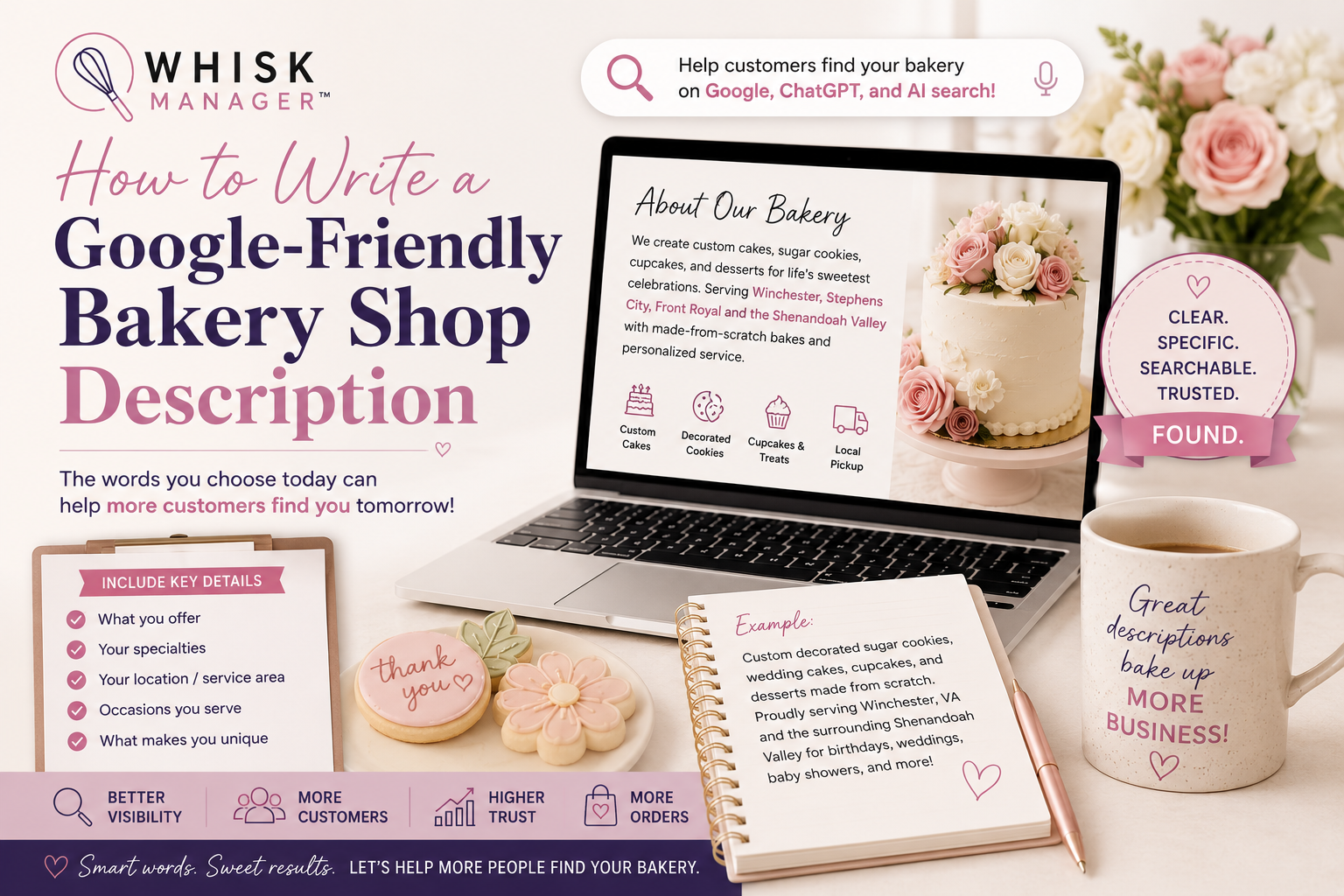
How to Write a Google-Friendly Bakery Shop Description
Learn how to write a bakery shop description that ranks on Google, brings in local customers, and still sounds like you. Templates and examples included.
You know your bakery inside and out. Getting that into words Google actually understands — and customers actually want to read — is a different skill entirely.
Most bakery descriptions fall into one of two traps. They're either so generic ("We bake with love and the freshest ingredients!") that Google has nothing to grab onto, or they're written for search engines and read like a keyword list a human would never say out loud. The description that actually works does both jobs at once: it tells Google exactly what you do and where you do it, while sounding like a real baker wrote it.
Here's how to write one.
Where your bakery description actually lives
Before you write a word, know that "bakery description" usually means three different things, and each one has different rules:
- Your Google Business Profile description — the 750-character blurb that shows up when someone searches your business name or "bakery near me." This is the one most people mean when they say "Google-friendly."
- Your website's About page or homepage intro — longer, more storytelling-driven, but still crawled and indexed by Google.
- Your shop/product page descriptions — shorter, more transactional, tied to individual items or services.
This guide focuses mainly on #1 and #2, since those are what get you found in local search — but the same principles carry through everywhere.
1. Lead with what you do and where you do it
Google's local algorithm is trying to answer one question: what is this business, and is it relevant to what someone just searched? Your first sentence should answer that plainly, before you get to your story or your voice.
Weak opener: "Once upon a time, a lifelong love of baking turned into a dream."
Strong opener: "Sunnyvale Sweet Studio is a custom cake and cookie bakery in Sunnyvale, CA, specializing in wedding cakes, birthday cakes, and custom cookie orders."
That second version gives Google (and the reader) your business type, your location, and your specialty in one breath. Save the origin story for sentence two or three.
2. Use the words your customers actually search
Skip industry jargon and think like a customer typing into Google at 11pm. People search "custom birthday cake near me," "gluten-free cupcakes [city]," or "wedding cake baker [city]" — not "bespoke confectionery artisan."
Work in the specific terms for what you make and who you make it for: wedding cakes, custom cookies, cupcake towers, gluten-free, vegan, dairy-free, birthday cakes, gender reveal cakes, corporate orders, cake pops, macarons. Pick the ones that are actually true for your business — don't pad the list just to rank for things you don't do. A mismatched search result is worse for you than no result at all.
3. Name your city and neighborhood — more than once
Local SEO lives and dies on location signals. Your city name should appear naturally at least twice: once near the top, and once when you mention delivery, pickup, or service area.
Example: "We're a home bakery based in Aurora, serving custom cakes and desserts throughout the greater Denver metro area, with local pickup and delivery available."
If you serve a specific radius or list of towns, name them. "Serving Aurora, Denver, and Centennial" tells Google exactly which searches to show you in.
4. Write it like a person, not a listicle
Google's systems are increasingly good at spotting descriptions that were clearly stuffed with keywords and no soul — and so are customers. The goal is natural language that happens to contain the right terms, not a checklist disguised as a sentence.
Compare:
"Bakery cakes custom cakes wedding cakes birthday cakes cupcakes bakery near me best bakery."
vs.
"I'm Jennifer, a national cake decorating teacher and the baker behind every order at our home bakery. We specialize in custom wedding cakes, birthday cakes, and cookies made from scratch — no mixes, no shortcuts."
The second one ranks better in the long run because people actually read it, click through, and stick around — all signals Google tracks.
5. Answer the question behind the search
Someone searching "bakery near me" usually wants to know: what do you make, is it good, can I get it in time, and can I trust you. A strong description answers as many of those as it can in a few sentences — credentials, specialties, turnaround expectations, and what makes you different from the bakery three exits away.
If you have a credential, contest win, press mention, or a genuinely unusual specialty (allergy-friendly, a signature flavor, decades of experience), that's your differentiator — lead with it after your opening line.
6. Keep it within the limits
For your Google Business Profile, you get 750 characters, but only the first ~250 show without a "read more" click — so put your most important information (business type, location, specialty) in that first stretch. For your website's About page, you have more room to breathe and tell the full story, but the same opening-sentence rule still applies: don't bury the lede in three paragraphs of backstory before Google (or the reader) learns what you actually sell.
A simple template to start from
[Business name] is a [business type] in [city/area], specializing in [2–4 specialties]. [One sentence of credibility, story, or differentiator.] We offer [pickup/delivery/shipping details] to [service area]. [Optional: call to action — order online, book a consultation, visit our shop].
Filled in:
Tiers in Heaven is a custom wedding cake studio based in [city], specializing in tiered wedding cakes, dessert tables, and cake tastings by appointment. Founded by a national cake decorating instructor, we bring competition-level detail to every order. We offer local delivery and setup throughout the [region] area. Book your consultation today.
Don't stop at the description
A great description gets you found — but what happens after someone clicks matters just as much. Your website, your online shop, and how quickly you can turn an inquiry into a booked order all factor into whether that search turns into a sale.
That's the gap Whisk Manager was built to close. It's an all-in-one business management app for home bakers, cake artists, and cookie decorators — built by a working baker who couldn't find a tool that fit a small cake business, so she built one. Recipe costing, quotes and contracts, a client portal, and a storefront that's ready for the customers your new description brings in.
Smarter Baking. Better Business.